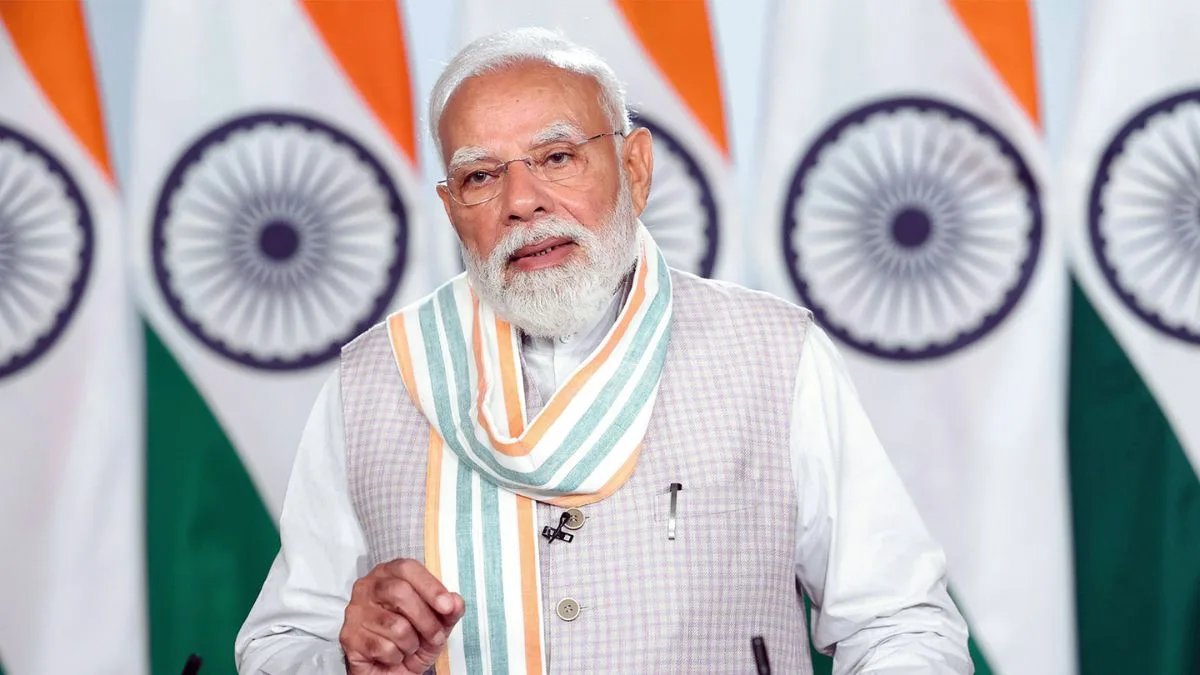
With the aim of giving new momentum to the central government’s resolve of ‘Viksit Bharat, Viksit West Bengal’, Prime Minister Narendra Modi will inaugurate, dedicate to the nation, and lay the foundation stone for several important projects in various sectors such as agriculture, rural development, fisheries, and railways in West Bengal’s Hooghly district on June 20.
During the event, the PM will release the 23rd instalment of the Pradhan Mantri Kisan Samman Nidhi (PM-KISAN) and also launch important initiatives, including the Pradhan Mantri Fasal Bima Yojana, the restructured Weather-Based Crop Insurance Scheme, Agritech under the Digital Agriculture Mission, the National Natural Farming Mission and the Pradhan Mantri Dhan-Dhaanya Krishi Yojana. These initiatives are aimed at boosting farmers’ incomes, strengthening rural infrastructure, promoting inclusive development, and transforming West Bengal’s agricultural landscape.
Advertisement
Union Minister for Agriculture and Farmers’ Welfare and Rural Development Shivraj Singh Chouhan said that the national-level programme to be held in West Bengal, with Prime Minister Narendra Modi as the chief guest, will prove to be a historic opportunity for farmers, rural communities and youth.
He said that under the leadership of Prime Minister Narendra Modi, the central government is committed to transforming eastern India into a strong centre of agriculture, infrastructure and industrial development. The programme on June 20, he added, marks an important milestone in translating this vision into reality.
Chouhan said that during the programme, PM Modi will release the 23rd instalment of ‘PM-KISAN’ from Tarakeswar in Hooghly district. Under the scheme, around Rs 18,880 crore will be transferred directly into the bank accounts of more than 9.44 crore farmers across the country through Direct Benefit Transfer (DBT), strengthening the income security of small and marginal farmers.
He added that in West Bengal alone, more than 45.35 lakh beneficiary farmers will receive an instalment of approximately Rs 907 crore. With this disbursal, the total amount distributed under the PM-KISAN scheme in the state will exceed Rs 15,055 crore, while the total distribution across the country since the scheme’s launch in 2019 will exceed Rs 4.46 lakh crore.
The Union Agriculture Minister informed that PM Modi will also launch the Pradhan Mantri Fasal Bima Yojana (PMFBY) and the restructured Weather-Based Crop Insurance Scheme (RWBCIS) in West Bengal, whose combined cost is approximately Rs 12,200 crore.
During the financial year 2026-27, the target has been set to provide crop insurance security to approximately 1.10 crore farmers on 30 lakh hectares of agricultural land under these schemes, under which crops worth approximately Rs 28,140 crore will come under insurance protection.
Chouhan said that under the Digital Agriculture Mission, PM Modi will launch the Agritech platform in West Bengal, which will provide an integrated digital platform for services such as fertiliser distribution, Kisan Credit Card, direct benefit transfer and government procurement based on Minimum Support Price (MSP). This will provide timely information, transparent services and better market opportunities to farmers.
The Union Agriculture Minister said that the Prime Minister will also launch the National Mission on Natural Farming, under which, according to the approved action plan, 346 natural farming clusters will be established in 17,300 hectares of the state in the financial year 2026-27. These clusters will benefit 43,250 farmers with bio-based inputs, training and better access to markets, along with encouraging large-scale transformation in the direction of natural farming through bio-based resource centres and agricultural friends.
Along with this, PM Modi will also launch the Pradhan Mantri Dhan-Dhaanya Krishi Yojana, which will be implemented in Purulia, Darjeeling, Alipurduar and Jhargram districts.
The objective of this scheme is to increase agricultural productivity, encourage crop diversification, strengthen post-harvest infrastructure, such as storage and processing, and ensure integrated implementation of various rural development schemes, which will create new employment and entrepreneurship opportunities for farmers and rural youth.